Showing posts with label science. Show all posts

Friday, April 16, 2010

Charles Darwin Would Love to Play Spore


Spore is a game made by Maxis and designed by Will Wright. In 2008, Spore was released for Windows and Macintosh. Today, the game is available for Wii, PC Games, Web, Xbox 360, PS3, PlayStation 2, Nintendo DS and Mobile.

The game has many genres like RPG, strategy and action. This game lets the player have control over the development of an organism from the cellular level to a whole and intelligent creature. The player can make the organism evolve and to explore water, land and the space between the star systems within a galaxy.

This is a very fun game that teaches players the most important ideas of Charles Darwin like The Survival of The Fittest and how Natural Selection favors certain organisms to evolve and survive through many stages (generations) until he becomes so strong that he can conquer the galaxy.


The Cell Stage

This the first stage of the game, teaches the scientific concept of panspermia (in Greek pan means “all” and spermia means “seed.” The hypothesis of panspermia tells that the life on Earth originated from seeds of life that are all over the universe). The concept of panspermia is shown by the crash of a meteor in the ocean of a planet giving origin to a prokaryotic (single cell) organism.

The organism has to evolve in order to progress. The player has to guide the prokaryote through a liquid environment, where it can find other simple organism to eat or big predators that can eat him. The player can decide if the creature will eat plants or meat. Later on, the creature evolves and can eat both.

The eating habits that the organism acquires in the cell stage directly influences the next stage (creature stage). Only feeding structures (for plants, meat or both) that the creature uses in the cell stage will be available for the creature stage. However, the player can change the feeding structures of the creature before entering the creature stage.

As the creature evolves, the player will have to add legs for the transition to land. When the creature is out from the water will join a nest with other nest mates.


The Creature Stage

The creature stage contains different animal species. This stage shows and teaches the distinction of carnivores, herbivores and omnivores. In other words, the player can find animals that eat meat, plants or both. In this stage the player has to take care of the health and hunger of the creature.

When the creature explores the land will find other kinds of creatures with their nests. Some creatures will be powerful and will have los of babies or others will be weak. The player can decide if the creature will be friendly or attack the creatures. If the player is friendly to the other creatures, they will be friendly with him, but if the player attacks them, the creatures will get very angry and attack him.

This is a very good way to teach the concept of Natural Selection to the players. The most powerful creatures are the ones that have more mates and can reproduce more successfully than others. The players will learn the importance of “The Survival of the Fittest” between different species on land.

Equally important, the player will learn that the only way of species to survive is in a group. Like Charles Darwin would say, they will never make it alone. He will learn this by socializing and hunting with other creatures.

The more time that the player socializes with other creatures; the more points that he will get and his DNA will become stronger. The interaction with other creatures will allow the player to form a pack that will follow him and help him to fight or to heal.

The importance of reproduction is observed in the game. Reproduction has a very important role in evolution. In the game, the player has to mate his creature with other members of the nest (they have to be from the same species otherwise they cannot mate).

After the creature mates, the player can change the creature and make it stronger and totally different from the old version. This will show how a new and a stronger generation can be the result of a successful mating.

The creature’s brain will evolve and become more intelligent as the player socializes and hunts with other creatures. When the creature intelligence has reached a certain point, the player enters the next stage.


The Tribal Stage

In this stage the biological development of the creature stops. The player cannot longer control the individual creature. From here on, the player has to take care of the whole species or tribe. The player will have a hut and a pack of evolved creatures to play.

The creatures can interact with other tribes and learn to speak. Other creatures can be added to the pack like pets that will make eggs for food and the creatures can wear clothes, use tools and musical instruments.

Creatures give birth to babies that will become members of the tribe. When they grow, they can gather food, attack other tribes, hunt for food and become friend of other tribes.

The player will face 5 different tribes. Three tribes are aggressive and the player can decide to be friendly or to attack them. A piece of a totem pole is built for every tribe that is destroyed or became a friend.

The sculpture will allow the player to increase the tribe population number or will provide more tools for the population. When the totem pole has 5 pieces and the player’s tribe has become the dominant tribe, the player can move to the next stage.


The Civilization Stage

In this stage, the player’s tribe has divided into different nations, like in reality. The player controls one of the nations. The purpose of this stage is to get control of the whole planet. The player can decide to conquer the planet by the economy, religion or military.

If the player wants to conquer the planet by the economy, he can trade and buy cities. In the pet hand if the player wants to control the planet by the religion, he will have to convert all the cities to the player by religious domination.

The player can mark his territory by making vehicles and buildings and adding specific color to define the territory boundary. The territory will increase as the player gains more power by conquering cities and nations. When the player conquers the planet, he will move to the next and final stage.


The Space Stage

In this stage, the player will spread through the galaxy with the purpose of colonizing planets. The player will be able to manipulate the planets by altering the ecosystem, temperature and the atmospheric conditions to kill the inhabitants in order to conquer the planets. He can also make changes in the planet to make it a better habitat.

The player can abduct creatures and transport them to different planets to test the environmental conditions to create ecosystems. In addition, the player can trigger life in a planet by placing a monolith.

The player can interact with other ‘space civilizations’ that are called empires and form allies. He can conquer the galaxy by creating a federation or an interstellar war.

Monday, April 5, 2010

Bioinformatics & Computational Biology

I went to the Bioinformatics and Computational Biology laboratory of Dr. El-Sayed to take some photos that will show how technology is used in the University of Maryland to do scientific research. I also used the one thirds rule of photography discussed in the course Information 3.0. Bioinformatics is the latest field that evolved from Biology and the technology that is used is the latest too.


Dr. El-Sayed laboratory works with three pathogens: Trypanosoma brucei, Trypanosoma cruzi and Leishmania major. Trypanosoma is the agent that causes sleeping sickness and continues to affect populations in Africa and South America. The main goal of the lab is to sequence the Trypanosoma genome to find a way to make a vaccine that will exterminate the pathogen and won't harm the human host.


Laboratory assistant of Dr. El-Sayed performing research.

The lab is currently working with a technique that is called the Yeast 2 Hybrid System. The purpose of the assay is to find a Trypanosoma protein that is affecting a human protein. When the protein is found, the team can sequence it and analyze it. Then they can compare the sequence with sequences of other species to see what the protein does and ways to target it.


This machine transfers cells that are infected with Trypanosoma to a medium where only the cells that are affected by the Trypanosoma protein can survive. Then, the cells grow and can be sequenced.


This photo shows that many the machine can tranfer many plates at the same time. In fact, 200 plates can be transferred each time.


Posted by Picasa
The rectangular plate shows the cells that the machine transfers to a different medium. Every dot represent a colony of cells that only grows if is infected by the Trypanosomaprotein. Only the ones that grow are visible to the human eye.


Sunday, April 4, 2010

Analyzing Scientific Shots

The evolution of science was always link to journalism. Journalists let people know about scientific discoveries and new technology. Journalists use their cameras to capture and reinforce a story. However, not every individual can take a perfect photograph.

The quality of the image depends of the individual’s performance. Photography is an art that requires an artist. The photographer has to learn and practice how to take a good picture. Like artists, they have to practice to improve their work.

To take pictures of a lab or scientists is not easy. One reason might be because the labs have very big machines that can cover most of screen. However, to take pictures of smaller objectives like scientists working is easier than from big machines.

For Example, the
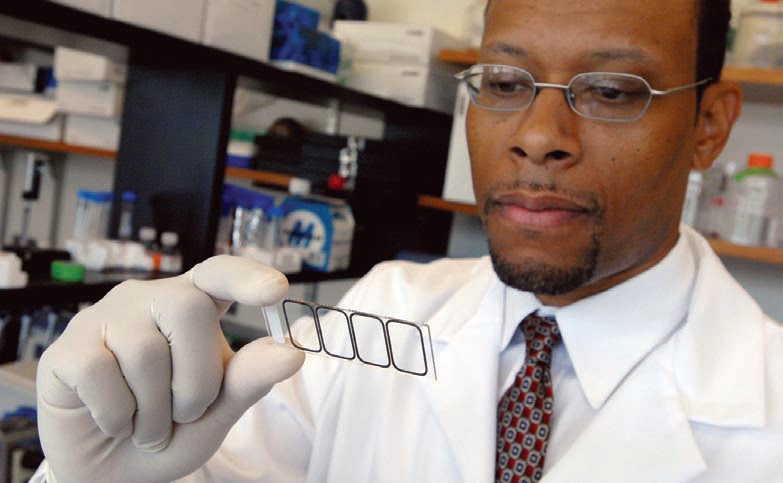
photo below is very well taken. The photo is a very good example of the rule of thirds (never place your objective in the center of the screen).The photographer focused the scientist on the left of the screen and the coverslip a little below the center of the screen In addition, the hand of the scientist was located on the left of the screen.


The photographer gave emphasis to the hand holding the cover slit by getting a close up of the hand holding the coversilp. Also, the colors are very clear and show a very clean shot. I can tell that the photographer used a very nice camera.

The photographer edited the photo very well. He increased the intensity of the colors of the scientist and made the background colors a little blurry. The objective of the photographer is very easy to visualize and to understand.

In the other hand, the
photo below is not so good like the previous photo. The photographer used the rule of thirds by putting the scientist on the right of the screen, but not enough. If the photographer located the scientist a little more on the right, the picture would look better.


In addition, the background at the right of the girl makes the picture look low quality. The picture shows that the photographer objective was the scientist, but maybe that was not the case. If the main objective were the hands, the photographer should have focused the hands at the right and not at the center of the screen.

If the main objective were the hands, the photographer violated the rule of thirds because he located the scientist’s hands at the center of the screen. Even, if the hands were not the main objective, the shot would have been better if the photographer put the scientist all the way at the right of the screen.

Equally important, I can tell that this picture was not edited well enough. For example, the colors are not so clear like the previous photo. In the previous photo, the colors were edited to emphasize the view of the scientist instead of the background. However, in this photo, the scientist and background share the same intensity of colors. If the photographer gave to the scientist higher color intensity, the photo would look much better.

Thursday, March 25, 2010

Technology reveals King Tut's Mystery


The kingdom of King Tut was one of the most extraordinary kingdoms. The late18th dynasty gave rise to Akhenaten. This was a very special pharaoh. Before Akhenaten became the pharaoh, Egypt was a polytheist country. However, when he became the king, he made Egypt to switch to a single religion and change the main capital (Thebes) to Tel-el- Amarna. He introduced a new capital and a new god, Aten.

The change of religion and capital made a huge impact in the country. Some people didn’t like Akhenaten; some people refer to him as the “heretic pharaoh”. He became the father of Tutankhamun. When Akhenaten died, Tutankhamun became the new pharaoh at the age of about 9. He switched back to the old religion and switched back the main capital of Tel-el-Amarna to Thebes.

For many years, the cause of death of King Tut and the identity of his ancestors was not well known. In fact, archeologists have found many royal mummies, but technology was not able to reveal their identity and relationship to King Tut.

A multidisciplinary scientific approach based on molecular and medical Egyptology was used to determine the identity and relationship between royal mummies, health problems and their provable cause of death.

It is very impressive how now technology can be used to reveal very specific information of 11 mummies that lived in a period, circa 1410-1324 and 5 mummies that lived in a period, circa 1550-1479 BC. That is like 3,500 years ago.

Results

King Tut’s family tree

Genetic fingerprinting created a 5 generation pedigree of King Tut’ lineage. They look for similar microsatellites in the mummies DNA. Microsatellites are repeats of 1-6 units of DNA. The mummies that had the same repeats are related by blood.


I. Yuya and Tuya were the great-grandparents.
II. Amenhotep III and Tiye were the grandparents
III. Akhenaten and mummy KV35YL (unknown) were the parents and siblings.
IV. Tutankhamun, his wife and KV21A (unknown)
V. Fetus 1 and 2 (unknown) were King Tut’s children

According to the microsatellites they found out that King Tut was the product of a consanguineous marriage. The double line between Akhenaten and his unknown wife represents consanguinity. Inbreeding brought many health problems to king Tut.

King Tut’s foot

King Tut was examined radiologically and a CT reconstruction of his feet reveals that the left foot was deformed and had bone necrosis (bone tissue dying). The image below shows the deformed left foot and the normal right foot. This finding explains why numerous walking sticks were found in King Tut’s tomb.


King’s Tut’s cause of death


The scientist did genetic testing to look for DNA of plasmodium in King Tut. They found that King Tut had plasmodial DNA. Plasmodium is the agent of malaria. According to the study, King’s Tut had the most aggressive form of malaria.

Generally, African populations that are exposed most of the time to malaria develop a self defense mechanism that reduces the mortality of malaria by decreasing the symptoms of the malarial inflammation. When the organism reduces the response to the inflammation, there is enough time to fight and clear the disease. People that cannot reduce the response to the inflammation usually die.

Scientists believe that King Tut died of malaria. He was too week to reduce the response to the malarial inflammation because of the severe bone necrosis.

In addition to malaria tropica, scientists found that King Tut had a leg fracture, cleft palate, pes planus, oligodactyly (fewer than 5 fingers or toes), and kyphoscoliosis (abnormal curvature of the spine). He got a mixture of scoliosis (curvature of the spine) and kyphosis (hunchback). Akhenaten and his sister had scoliosis. When they got married they provably gave King Tut a severe type of scoliosis and many other health problems due to a consanguineous marriage.

Friday, March 19, 2010

King Tut's Curse


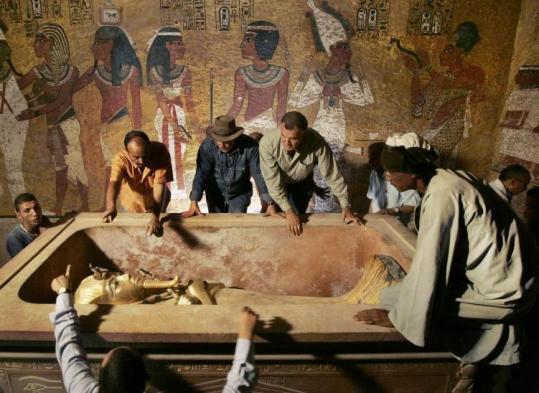
In 1922, Lord Carnarvon sponsored the archeological expedition of the archeologist Howard Carter. The purpose of the expedition was to discover the tomb of Tutankhamen. The tomb of Tutankhamen was very special because the seal was not broken. The difference with other tombs is that thieves broke into the tombs to steal everything they could. However, Tutankhamen tomb was not desecrated. Tutankhamun was found with all his treasure in the same location where the old Egyptians left him in 1323 BC. Before Carter entered the tomb, he noticed a warning that said: “They who enter this sacred tomb shall swift be visited by wings of death.” He ignored the warning and broke the seal, entered into the tomb and collected everything that was inside. He even kept some of Tutankhamun’s furniture and used it to decorate his home for a while.


It is not clear that the curse that Carter found at the tomb entrance was exactly the same as the one described above. He denied the fact that there was a curse. Some people think that as soon as he found the inscription, he hided it that way the workers did not leave the excavation. At the time of the pharaohs, Egypt was a very religious and a polytheist country. In fact, Tutankhamun was the one that returned to Egypt the polytheism that was taken away by his father Akhenaten. Religion was a very important part of Tutankhamun’s life and regime. It is possible that an inscription was put at the entrance of the tomb to protect the Pharaoh from thieves or desecration and that Carter found it.


The discovery of Tutankhamun was one of the most important discoveries of the twenty century. According to the curse people thought that when someone breaks the seal will be cursed and die. Maybe that was one of the reasons why the tomb of Tutankhamun was intact when Carter found it. According to the curse, everybody that enters the tomb will die. The curse became even scarier when Lord Carnarvon and his dog died six weeks after the official opening of the burial chamber of Tutankhamun. He died of an insect bite infection.


Even more strange, when the mummy of Tutankhamun was unwrapped in 1925, it was found to have a wound on the left cheek in the same exact position as the insect bite on Carnarvon that lead to his death.”


The archeologist Zahi Hawass says that the reason why most of the Egyptian artifacts are taken to the museums is because they want to prevent people entering the tombs. The reason why is the Egyptian curses. If tourists keep entering the tombs, they will be cursed and bad things will happen to them.


The following chart and data shows some of the people who died after entering the tomb.


EVENT

NUMBER OF PEOPLE THERE

NUMBER OF DEATHS AFTER 10 YEARS

Burial chamber opening

26

6

Sarcophagus opening

22

2

Mummy unwrapping

10

0


Lord Carnarvon:

Carnarvon had been in poor health for over 20 years following a motoring accident in Germany. Less than two weeks after the official opening of the burial chamber, Carnarvon received a mosquito bite which became infected after he cut it while shaving. Carnarvon fell ill and, with his resistance lowered, came down with pneumonia and eventually passed away at the age of 57.

Howard Carter:

As discoverer of the tomb, Carter should have been Number 1 on the curse's "hit list", but he survived until March 1939, just short of his 65th birthday and nearly 17 years after entering the tomb - about a decade of which was spent working in the tomb itself.

Lady Evelyn Herbert:

Lady Evelyn, Lord Carnarvon's daughter and one of the first into the tomb, died in 1980 at the age of about 79.

Harry Burton:

Burton was the photographer loaned to Carter by New York's Metropolitan Museum of Art to document the work done in Tutankhamun's tomb. Many of the magnificent black & white photographs of the time were taken by Burton who died in 1940.

Alan Gardiner:

Gardiner studied the tomb's inscriptions and was still very active working on Egyptian grammar for many decades until his death in 1963.

Dr D. E. Derry:

Derry carried out the original autopsy on Tutankhamen’s mummy. If anyone should have been cursed along with Carter, it probably should have been Derry, but he didn't die until 1969.

Saturday, February 20, 2010

Personality and Science


To become scientists, students need to have a different kind personality. Most of the time, students that are extroverts cannot pass the classes that are required for their science major. This happens to many students in their first year of college. They get into a science major and then, they get frustrated with their grades and end up changing their major. For example, when you enter to a freshman biology course in a university you could see more than 200 students, but if you enter to a senior biology class you would provably see about 30 students.

The question is how students know that they have the drive and personality to become a scientist? Well, the answer is not that simple, but there are some personality traits that scientist have that distinguish them from other people. First, it is important to mention that to become a scientist the student doesn't need to be a “nerd.” Some people think that scientists are always nerds, which is not true. Here I will make a list of scientific personality traits that most of scientists have:

They never procrastinate- Science is a very difficult field to study if students leave everything for the last minute, they won’t make it.

Punctuality
- It is important to be in class or any meeting on time.
Prefer science than parties- Students should know when to party and when to study. If there is an exam, they cannot party.

Take care of body and mind- To go through science is necessary to have the body and mind ready. Physical activity relieves the tension and stress from the mind.

A balance between introvert and extrovert
- When students have to study, they cannot go out to have fun. They should be in their rooms studying until they learn the material. However, if there are not exams or assignments to do, they can go out and have fun.

There are many more personality traits that scientists have, but to become a scientist those are the most important. A scientific life is not a boring or stressful life. It is just a balance between responsibility, work, fitness and fun.

Picture source: picture book

Friday, February 19, 2010

Protecting Gender Identity and Genetic Information


People should not be judged based on their sexual preference, gender identity or genetic information. “All of us are to be judged based on our skills, ability and work ethic.”(Goldner).

The gender identity and genetic information of many people could soon be protected under a law by Fort Wayne city council in Indianapolis. Karen Goldner /(D) Fort Wayne Council 2nd District submitted a bill to amend a law that protects people against discrimination. Goldner says that the idea is to put gender identity into the same category as sexual orientation, because sexual orientation is already protected by law.

Lanka says, “People who believe they have been discriminated against by a business based on sexual orientation can petition the city’s Metropolitan Human Relations Commission to investigate the complaint.” People that are attracted to the same gender, have a different gender appearance to the one they are born with or people that are discriminated because of their gender role in some kind of situation would be able to petition the city’s Metropolitan Human Relations Commission to investigate the case in the same way as a sexual orientation investigation. Goldner says that this law will ensure that people will be treated equally.

“The federal law, called the Genetic Information Nondiscrimination Act, went into effect last year. It prohibits health insurers and employers from using genetic information to determine insurance coverage or rates, or to make hiring, firing and promotion decisions” (Genetics data law raises concern [Chattanooga Times Free Press, Tenn.]).

In addition, Goldner wants to protect the genetic information locally. In fact, she wants that the law from the local ordinances would be equal to the federal law. She thinks that protecting the genetic information “would prevent an insurance company from denying health insurance to a woman who was found to have a gene linked to breast cancer” (Goldner).

“The genetic information section follows the federal law preventing companies from using a person’s genetic information to discriminate” (Lanka). It is important to mention that local ordinances will soon start protecting people from genetic discrimination. This will prevent people traveling to other places to make complaints. For example, people in Indiana won’t have to travel to Indianapolis to make a genetic discrimination complaint. It will be easy for people that don’t have access to a car or are disabled.


Picture:
Gender Identity." Gender Identity Ordinace is put to FW. City Council. Web. 19 Feb 2010.
<http://www.indianasnewscenter.com>.


Sources:
"Genetics data law raises concern [Chattanooga Times Free Press, Tenn.]." Feb 14 2010: n. pag. Web. 19 Feb 2010. <http://insurancenewsnet.com>.

Neumeyer, Jeff. "Gender Identity Ordinace is put to FW. City Council." 9 Feb 2010: n. pag. Web. 19 Feb 2010. <http://www.indianasnewscenter.com>.

Lanka, Benjamin. "Shield sought for gender ID, genetics." Feb 6 2010 : n. pag. Web. 19 Feb 2010. <http://www.journalgazette.net>.


Monday, February 15, 2010

Addiction to Technology


After reading,"Personality and Self-Esteeem as Predictors of Young People's Technology Use." I think that certain personalities engage in certain technological behaviors because people that have a specific type of personality will chose some kind of technology that will make them feel conformable with their personality and socializing. For example, according to the experiment, disagreeable students spend more time on calls because they prefer not to talk to people face-to-face because they have bad temper and argue al lot. Also, people that know them will prefer only to contact them by phone because they don’t like to argue with them face-to-face.

In the same way, neurotic students spend more time texting because it is difficult for them to socialize face-to-face or talking by phone. They feel more confident texting because they have control over the text. They can revise it and send it when they think is the right time. Because text-messaging is not so fast like IM, so neurotic students can take some time to think what information they want to send and correct it if they need it. In the other hand, disagreeable students prefer more IM because is faster than text-messaging. Their personality provably needs a faster response than neurotic students.

To describe addiction to technology they use three indicators of addiction:

1) Withdrawal – it is a physiological or psychological response that people addicted to technology experience when they do not text, talk by phone or do IM.

2) Loss of control – Spending most of the time talking by phone, texting or doing IM.

3) Salience – Thinking all the time about texting, calling or doing IM. They just want to text or IM all day. If they are not doing it. They are thinking on doing it.

I would define addiction as a condition where the individual can experience withdrawal symptoms if he or her doesn’t engage in his addictive behavior. The addictive behavior could be texting, IM or talking by phone. Addicts can spend most of the time engaged in their addictive behavior and the withdrawal symptoms could be anxiety, getting angry, not eating, etc.

The evidence in this study does not convince me that there is exactly a correlation of neurotic students and text-messaging or disagreeable students and talking by cell phones. First of all, 200 individuals is a very small number to be statistically significant. Statistical studies need large numbers to be significant. I think that there is some kind of truth that different kinds of personalities will prefer different types of technology, but the study is too small to tell that disagreeable individuals prefer mostly talking by phone or neurotic students prefer mostly texting.

Picture source: addiction

Saturday, February 13, 2010

Discovering The Structure of DNA

Technology plays a very important role educating individuals about the evolution of biology and genetics. Technology not only helps to educate people about science, but at the same time allows them to discover more valuable information. Those new findings help to educate students, professors, different fields of science and technology. In fact, technology was the principal factor that helped scientist to discover the structure of DNA. For example, X-ray crystallography is a type of technology that can make a three-dimensional picture of the arrangement of atoms or molecules within a crystal. In other words, when a beam of x-rays (type of light) hits a crystal, the light spreads out to different directions. As a result, the machine can make a three-dimensional picture of the structure of the crystal. This type of technology allowed scientists to study, and discover the structure of DNA.

This is the story. In 1950, Rosalind Franklin was a biologist that used X-ray crystallography to study the structure of DNA. She was specifically studying DNA fibers that had single DNA molecules. Because the technique of X-ray crystallography can only be applied to crystals, she had to crystallize the DNA molecules with salt to form crystal structures of DNA. She also had to adjust her X-ray crystallographer with a very small lens (micro-lens) to be able to take pictures of such small molecules. In 1952, she took a beautiful X-ray diffraction picture of DNA (below).

In 1953 Linus Paulin was a chemist and a X-ray crystallographer that published the wrong structure of DNA in The Proceedings of the National Academy of Sciences. He thought that DNA was a triple helix. Stephen Lawson says that Paulin’s triple-helical structure of DNA, “turn out to be one of the most famous mistakes in 20th-century science.”


At the same time, James D. Watson and Francis Crick were also doing research trying to figure out the structure of DNA. As soon as Watson knew about the work of Paulin, he took a copy of Paulin’s work and went to see his friend Wilkins. Wilkins was other scientist that was doing DNA diffraction research with Franklin. Wilkins always had conflicts with Franklin at work. He was provably jealous of Franklin’s work. That was provably the reason why he gave Watson the best X-ray refraction pictures of DNA that Franklin took (above). That picture showed that the structure of DNA was a double helix and not a triple helix like Paulin thought and published earlier. Watson and Crick reviewed the picture, studied it and created a double helix model of DNA. However, they had a little problem. The building blocks (bases) of their DNA model were sticking out. To correct it, they had to use the data from another scientist. The data they used was known as the Chargaff’s rules. Those rules were created by Erwin Chargaff and said that the building blocks of DNA (bases) are suppose to be inside the double helix or the backbone, not outside.When their model was fixed and reassembled, they published it in the journal Nature

In 1962, Wilkins, Watson and Crick received the Nobel Price for discovering the structure of DNA. Rosalind Franklin died of cancer of the ovary in 1958 and she did not get the Nobel Price.

In the twenty century, Franklin’s work was not well known. At that time, the newspaper, television and telephone were the only ways to know what was going on in the world. People could only trust the news papers, TV or journals about scientific discoveries. If they were suspicious or wanted to know about Franklin’s DNA diffraction work. They had to go to a library or try to find her original work. In the twenty century, technology was used mainly for communication purposes. But, today technology is used also for education. In fact, readers, students, parents, and everyone else can go online and find everything about Rosalin Franklin or the structure of DNA. People don’t need to be scientists to learn about science. The internet became such a huge network that a reader can access all kind of information from a computer.

Today, Franklin’s work and DNA information educate people everywhere. People can browse the web with their cell phones or they can find information of DNA even when we are in bed. Laptops, iphones, and now ipads allow individuals to access all the information about Watson & Crick that they want to learn. However, not all the information in the internet is accurate and can be used to educate readers about technology or DNA. Some information is not reliable and can confuse the readers. The challenge is that readers learn how to distinguish good from bad information and not to trust everything they read.

Sources of pictures:

"Molecular Structure of Nucleic Acids." Nature. Web. 13 Feb 2010.

"Rosalind Franklin Photo 51." Wikipedia. Web. 13 Feb 2010.
.
"The Triple Helix." Linus Pauling Institute Research Report. Web. 13 Feb 2010.
.

Wednesday, February 3, 2010

Discovering Genetics


In 1871 and 1872, Charles Darwin published, The descent of man and The Variation of Plants and Animals under Domestication, respectively. In both books Darwin talks about inherited characteristics. For example, he uses the word "pangenesis" (origin of the whole) to describe the mechanism for heredity and the word "gemmules" to describe heritable traits. The theory of pangenesis said that gemmules have heritable material from every part of the organism and the material is incorporated into the sperm and eggs. Below, we can read how Charles Darwin defined genes nine years after he published The Origin of Species. Today, those heritable traits are called genes. This is an example of how genetics and biology evolved from the ideas of Charles Darwin.

“It is universally admitted that the cells or units of the body increase by self-division, or proliferation, retaining the same nature, and that they ultimately become converted into the various tissues and substances of the body. But besides this means of increase I assume that the units throw off minute granules which are dispersed throughout the whole system; that these, when supplied with proper nutriment, multiply by self-division, and are ultimately developed into units like those from which they were originally derived. These granules may be called gemmules. They are collected from all parts of the system to constitute the sexual elements, and their development in the next generation forms the new being; but they are likewise capable of transmission in a dormant state to future generations and may then be developed (The Variation of Plants and Animals under Domestication).”

In 1860s, Mendel was a priest that was studying inheritable traits in pea plants. He knew about Charles Darwin’s theory, he agreed with some of his ideas, but no one knows why he never tried to contact him. Mendel came out with two laws.The Law of Segregation says that when an organism produces sex cells (eggs or sperm), genes separate and each cell receives only one copy of each gene. The Law of Independent Assortment says that genes assort independently during the formation of eggs or sperm. Those two laws became known as Mendel’s Laws. However, the importance if his work was not discovered until the 1900s.

In 1889, Hugo de Vries derived the word “pangen” from “pangenesis” to describe the units of the heritable material. In 1905, the biologist William Bateson shortened the term “pangen” to “gene.” Elemente der exakten Erblichkeitslehre was the first textbook that had the word “gene” and became one of the first textbooks of genetics. The field of genetics began in the early twenty century, when recently scientists realized the importance of Mendel’s work. Since that time, geneticists stared doing research to learn and discover more about genes and the mechanism of heredity.

To conclude, Charles Darwin is known as “the Newton of biology,” (Wallace) and Mendel is known as “the father of modern genetics.” Their work provided a strong foundation to the field of genetics and geneticists. In the next post, we will see how scientists started to use technology to discover more information about genetics.

Picture sources: Charles Darwin and Gregor Mendel

Monday, February 1, 2010

Introduction to Charles Darwin's Theory of Evolution


In 1859, when Charles Darwin published The Origin of Species, people didn’t know anything about the mechanisms of fertilization, genetics or paleontology. They didn’t have any human fossils to study the ancestry of man or a correct time-scale of evolution. After the scientists reviewed and accepted Darwin’s theory of evolution, The Origin of Species became one of the most important biology books. Sir Julian Huxley says that it is a “great book, one that after a century of scientific progress can still be read with profit by professional biologists.”


Darwin’s theory can be described in the following way. All organisms descended from a simpler common ancestor. Those organisms “descent by modification.” This expression means that living organisms acquired mutations or changes that allowed them to adapt and survive in different environments, temperatures or other kinds of selective pressure. In other words, natural selection that acts like a selective pressure favored organisms that developed mutations that allowed them to survive in harsh conditions. As a result, they reproduced and their offspring inherited the traits that helped them survive. Only organisms that inherited those specific traits were able to adapt to different environments.


“The survival of the fittest” is a powerful expression that Darwin used to explain how natural selection favors individuals that inherit different traits to survive and reproduce successfully. Darwin said that “it is not the strongest of the species that survive, nor the most intelligent, but the one most responsive to change"(Darwin). Darwin mentions that the heritable traits are the ones that allow organisms to survive different selective pressures.


Those traits are transferred from generation to generation and are favored by natural selection. In the next post, we will see how scientists started researching what were those heritable traits and how genetics developed from that point. Examples of research from the University of Maryland will be used to explain better technology and scientific research.

Picture source: Evolution